Provenance research
The MCAH began an ongoing inventory and historical study of its ethnographic collection in 2016. Most of the collection was built up through donations made to the museum by Swiss citizens between 1820 and 1980, including objects from Africa, North and South America, Asia and Oceania.
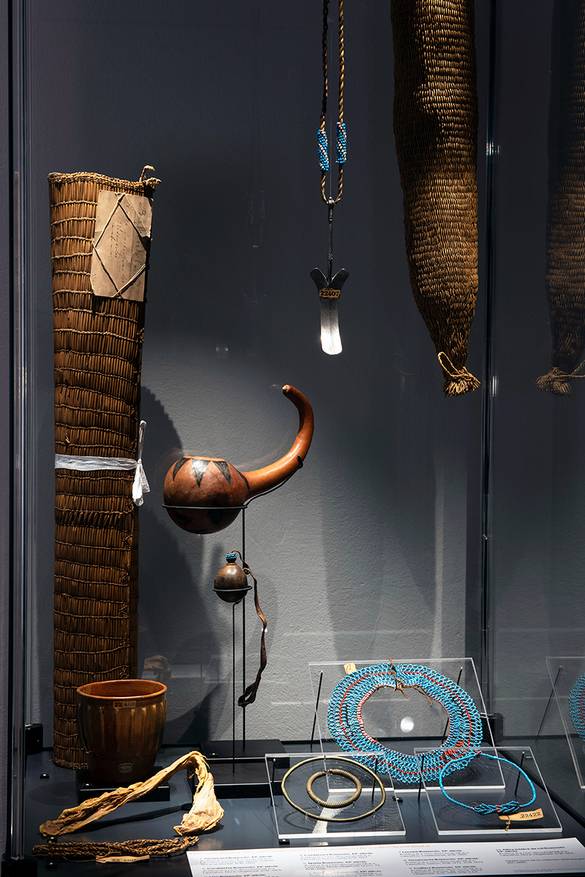
1. Showcase of the Ellenberger collection, from Lesotho, in the exhibition Retracer la provenance (MCAH, 12.10.2021 - 08.05.2022).
This historical research has provided material for several exhibitions, including Exotic ?, Retracer la provenance and Les collections invisibles du MCAH and given rise to the publication of special issues of the series entitled Patrimoines. Collections cantonales vaudoises. It has also revealed the existence of archives and collections from the same donors or geographical origins preserved in other museums and archive centres around Europe and the world.
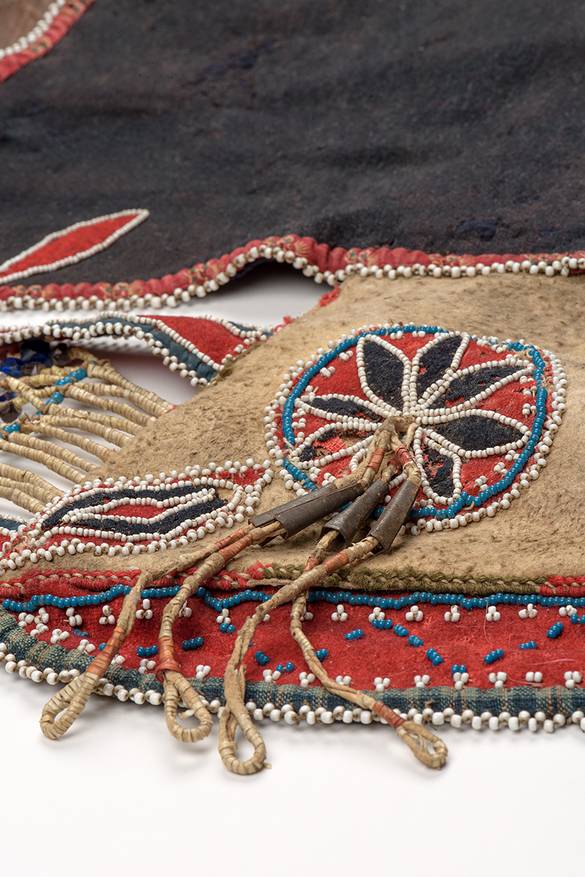
2. Detail of a pad saddle, 1st half of the 19th century, undocumented author, Upper Missouri Valley, North Dakota and Minnesota, skin, glass beads, metal, probably part of the Rodolphe Wyss Collection (Red River Colony) - gift ?, I/D-375.
This has made it possible to clearly identify the colonial provenance for some collections. Consequently, provenance research has become a major focus of research into the collection, as recommended by the ICOM Code of Ethics for Museums.
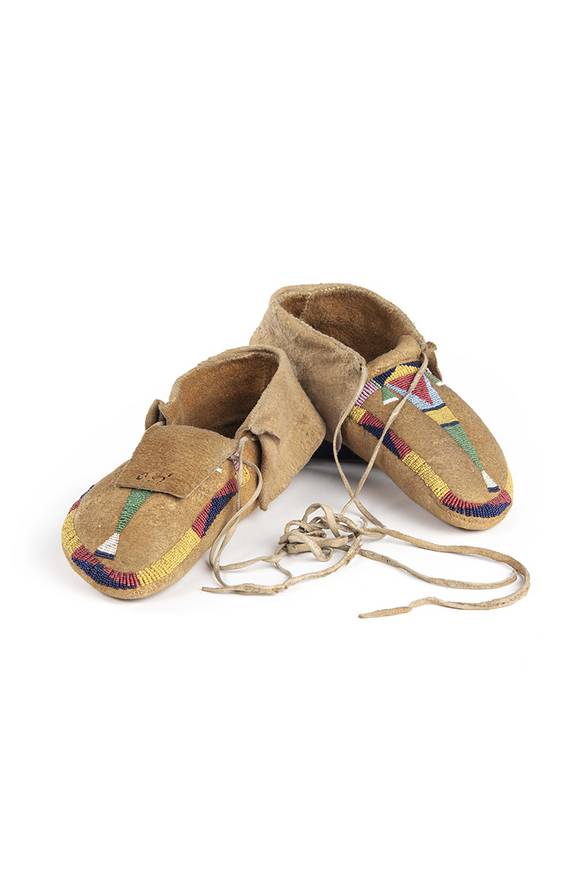
3. Pair of beaded moccasins, 20th century, undocumented author, Plains region, smoked buckskin, glass bead, Sister Aline Marie Gerber gift 1987, I/G-0326.
In 2023 and 2024, the MCAH was one of the museums to receive support from the Federal Office of Culture for provenance research. The report on this project, as well as all the studies carried out as part of it, are available online (links below).
Publications
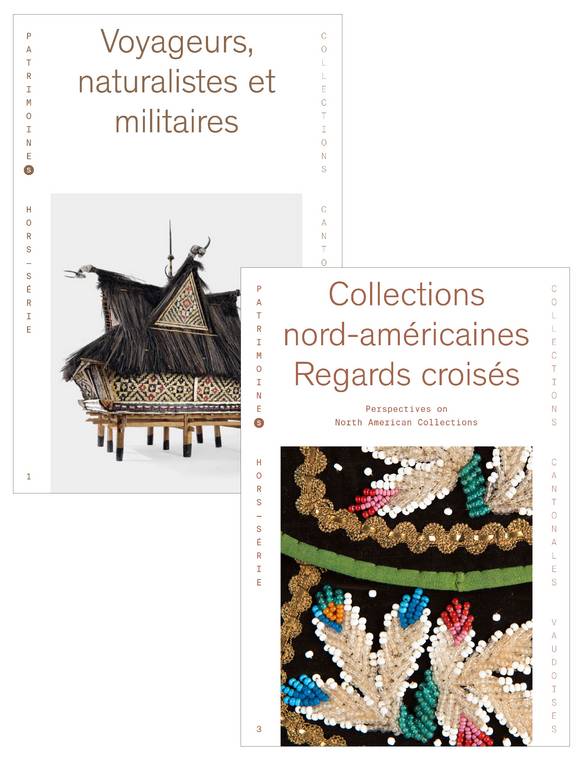
. Voyageurs, naturalistes et militaires. Des collectes dans les îles du Pacifique et de l’océan Indien aux réserves du Musée cantonal d’archéologie et d’histoire à Lausanne, Hors-série no 1, Patrimoines. Collections cantonales vaudoises. 2019. (in French)
. Collections nord-américaines. Regards croisés / Perspectives on North American Collections, Hors-série no 3, PatrimoineS. Collections cantonales vaudoises. 2024. (in French and English)
Project report
. Brizon, Claire. 2024. Rapport du projet de recherche de provenance soutenu par l’Office fédéral de la culture pour les années 2023-2024. Collection d’ethnographie du MCAH et origine coloniale ?
Studies reports and related publications
. Abegg, Claudine with Sabine Kammermann, Virginie Magnin and Claire Brizon. 2025. Anthropological, Pathological, and Historical Analyses of a Mummified Cranium From Bolivia Hosted in the Museum of Cantonal Archaeology and History of Lausanne, Switzerland. In. International Journal of Osteoarchaeology published by John Wiley & Sons Ltd
. Brizon, Claire. 2025. Peuplement. In. Sara Petrella, Mylène Steity (dir.), ABC arts & musées. Histoire coloniale et voix autochtones, Genève-Zurich : Seismo, p. 340-347
. Abegg, Claudine. 2024. Rapport d’étude anthropologique de quatre ensembles momifiés du musée cantonal d’archéologie et d’histoire de Lausanne (MCAH).
. Gallay, Audrey (dir.). 2024. Étude d’ossements de provenance extra-européenne, collection anthropologique du Musée cantonal d’archéologie et d’histoire (VD).
. Peers, Laura. 2024. Walter von Hauser and the pad saddle now at the Musée Cantonal d’archéologie et d’histoire (MCAH), Lausanne.
. Rast-Eicher, Antoinette. 2024. Selle amérindienne de Hudson Bay N.Y. du MCAH: Fibres et textiles.
Press review
. Lausanne fouille le passé de ses collectionneurs, Florence Millioud Henriques, 24Heures, 11.02.2023
. Ces œuvres qui rentrent au pays, Lena Wurgler, ARCINFO, 03.02.2023